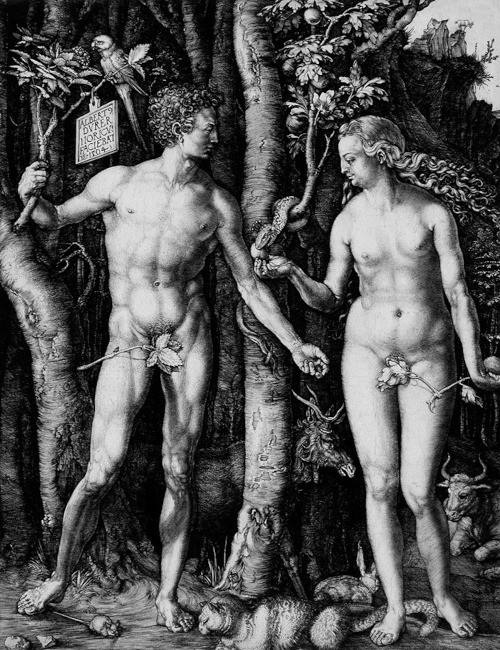
Evil and Sin?
At an unspecified time after the seventh day, and despite the fact that he had already made humans on the sixth day, Yahweh made a human male called Adam (Gen 2:7).
He placed Adam in a beautiful locale called the Garden of Eden. This garden contained trees of every kind including a “Tree of the Knowledge of Good and Evil” (Gen 2:8-9).
Yahweh forbade Adam, upon pain of death, to eat fruit from the “Tree of the Knowledge of Good and Evil” (Gen 2:17).
Even though Yahweh was omnibenevolent and could only make things that were good (cf., 1:31), the garden boasted a serpent who was “more crafty” than any of the other “wild animals” (Gen 3:1).
Due to the serpent’s advice Adam's mate ate of the forbidden fruit. However, after consuming it, she did not immediately acquire the knowledge of good and evil (3:1-6a).
Unaffected, she handed some of the fruit to Adam. Only after he ate did both the man and the woman simultaneously obtain the knowledge of good and evil (3:6b-7). As a consequence their descendants would all inherit original sin (Gen 3:16-19).
But the "word of God" also informs us that the first humans were created before Adam and Eve (Gen 1:26–31). Therefore, should not their descendants be quite sinless? Does not the Law of Moses state: “Fathers shall not be put to death for their sons, nor shall sons be put to death for their fathers; everyone shall be put to death for his own sin." (Deut 24:16)?