A Brief Overview
This book is aimed primarily at intelligent, perceptive individuals who may or may not have some applicable background knowledge and who would sincerely and genuinely like to become better informed about the evolution of Christianity.
I have tried very hard to include in this book the bare basics that would be needed to obtain a workable appreciation of what is a fairly complex discussion.
On your journey of discovery, I will often provide commentary to assist you in appreciating some of the more humorous and paradoxical aspects of trying to rationalise the irrational. In this regard, it is hoped that by the end of this book you will be suitably informed and properly enlightened. From that point, you can then specialise on any topic that you require. My extensive bibliography will more than aid you in this regard.
To obtain the maximum benefit from this book I strongly suggest that you read it in the order that it is presented. There is a good reason for its current organisation.
To fully appreciate the arguments put forward in this book a reader who does not enjoy the benefits of possessing decades of critical background information needs to be systematically informed apropos a wide range of key concepts. Later, once the book has been completed, the individual sections may be dipped into as needs be.
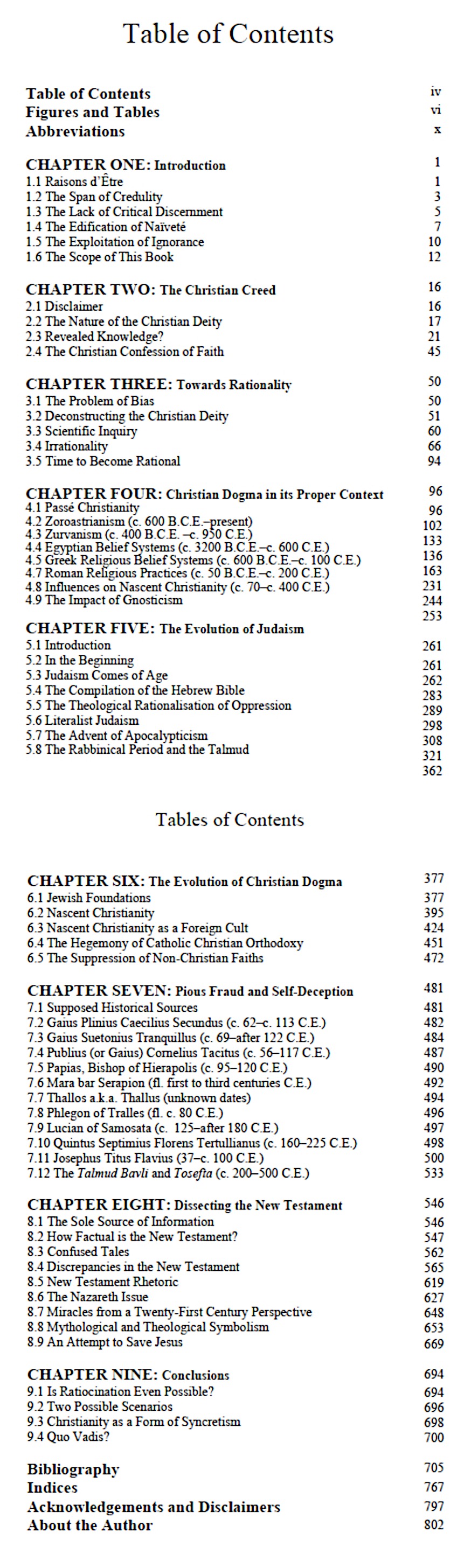
In Chapter Two, I briefly present the essential doctrine of fundamental Christianity as an important point of departure.
Chapter Three attempts to succinctly justify why we as truth-seeking, intelligent, rational, and critical human beings need to embrace the scientific method.
Chapter Four takes a brief look at other major religions and philosophies that have had a profound influence on Christianity. Here, I will introduce the reader to belief systems that anticipated many features of nascent Christianity, from Persia, Egypt, Syria, Greece, and Rome.
Chapter Five outlines, as accurately as possible, the known history and development of Judaism. Of particular importance, a reading of this chapter will substantiate that the Christian “God” and the Jewish “God” are not the same concept.
Chapter Six deals with the major influences on nascent Christian sects and the various dogmas that were manufactured, culminating with the Niceno-Constantinopolitan Creed (c. 381 C.E.).
In Chapter Seven, I look at all the claimed extra-biblical material that supposedly confirms the historical existence of the NT Jesus. As will be seen, none of the extant claimed material has any value. We will observe many attempts by the early church apologists to forge historical evidence.
In Chapter Eight, I show to what extent the NT is seriously flawed. It fails as a reliable history book but does contain much fiction, rhetoric, hyperbole, symbolism, innumerable contradictions, and many false claims regarding prophecy.
Finally, in Chapter Nine, based on the hard evidence contained in this book, I sum up how early Christianity evolved from various forms of Jewish and Hellenistic religious traditions.
Nicholas Peter Legh Allen Ph.D., D.Phil.